
What this document is
A partnership assessment and due-diligence framework for Operation Honor: Rural Salute®, operated by Veteran Help Point, Inc. — a 501(c)(3) public charity, EIN 87-3668518.
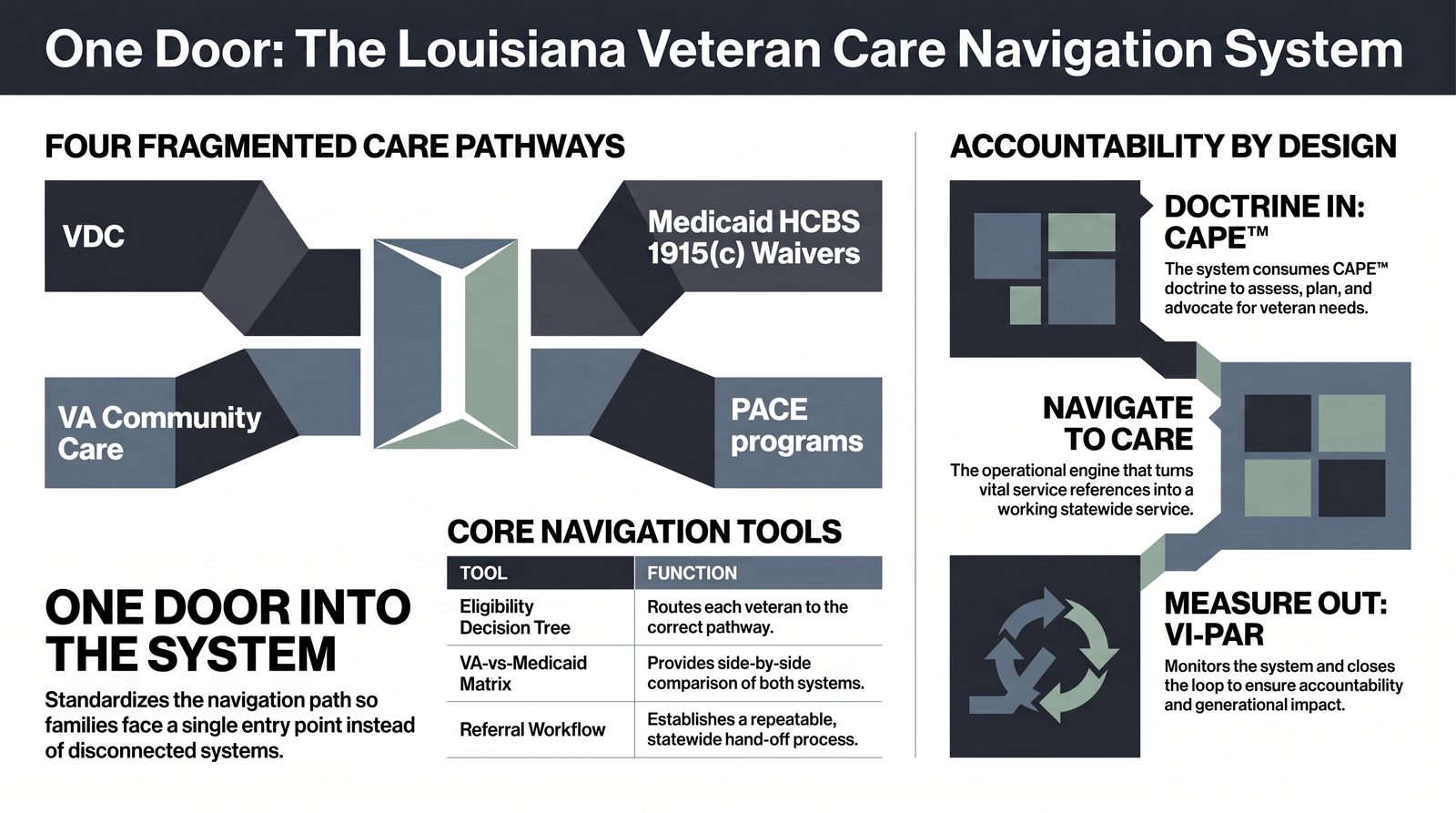
The problem it solves: veterans and caregivers face The problem it solves: strong mission alignment is not the same as verified partnership readiness. This separates the two so enthusiasm does not outrun diligence.. The framework standardizes the path so families face one door, not many.
It is designed to become a The recommended disposition is CONDITIONAL GO — open executive contact, begin verification, draft an MOU, but commit no money and exchange no protected data until the document list is satisfied. and a repeatable reference for the navigation team, with VI-PAR™ monitoring closing the loop.
What OHRS is, and is not
OHRS brings resources directly into rural communities through state-by-state events, a resource network, community partnerships and an online community. Its service categories span behavioural health, healthcare, employment, financial literacy, housing, benefits and claims, wellness and legal assistance.
Participation is free for Veterans, caregivers and organisations. Its 2026 schedule shows activity in North Carolina, Pennsylvania, Georgia and South Carolina — which makes a Gulf South conversation timely rather than speculative.
What it is not is a service-delivery organisation. It convenes, connects and refers. That gap is precisely where the Consortium fits.
Reach meets delivery
OHRS supplies reach, convening and a national network. The Consortium supplies assessment, navigation, deployment, intervention and measurement.
The value proposition is one sentence: OHRS connects the Veteran to the ecosystem; the Consortium operationalises the mission from assessment through verified outcome.
That division matters because the alternative — becoming another exhibitor at someone else’s event — produces contact counts and nothing else. A closed-loop model produces outcomes a funder will pay for.
A twelve-month Louisiana demonstration
Months 0 to 2 — diligence, leadership briefing, capabilities exchange, data and privacy assessment, referral standards, draft MOU, Board authorisation. Gate one: execute nothing until governance, financial, insurance, data and brand requirements resolve.
Months 2 to 4 — build the Louisiana provider network. Every participating provider gets a service profile, eligibility profile, referral protocol, response-time expectation and outcome-reporting requirement. Not a directory.
Months 4 to 9 — recurring rural deployments: pre-event outreach, registration, assessment, same-day triage, intervention, specialty referral, navigation, and 30/60/90-day follow-up.
Months 10 to 12 — a Louisiana Rural Veteran Impact Report. Gate two: renew, expand, modify or discontinue on measured outcomes.
What we confirm before we sign
Tax-exempt status is independently corroborated. Financial depth is not — public Form 990 data is thin, which can simply mean the organisation files the short 990-N. It is an open item, not a finding.
Before any MOU: IRS determination letter, three years of applicable filings, current board roster, articles and bylaws, conflict-of-interest policy, financial statements, insurance certificates, privacy and data-security policies, provider vetting procedures, outcome reports, brand licensing requirements, and any existing Louisiana partnership or exclusivity arrangement.
No material financial commitment occurs until that package is substantially complete.
What stays ours
M-TOC™, CAPE™, VI-PAR™, VINE™, VOTE™ and VEBOK™ remain the intellectual property of their respective Consortium entity unless expressly licensed under a separate written agreement.
The pilot is designed so the Consortium does not subsidise another organisation’s national expansion from unrestricted funds. A lean budget of roughly $125,000 to $250,000 should be carried predominantly by sponsorship, grants, in-kind contribution and shared infrastructure.
The risks worth naming: mission duplication, brand confusion, data-ownership dispute, incompatible provider standards, sponsor conflict, referral liability, and expansion outrunning infrastructure. Each is addressable in the MOU — none is addressable afterwards.
What the Board is being asked to authorise
Authorise executive leadership to open formal discussions with Veteran Help Point, Inc. concerning a Louisiana Rural Veterans Mission Integration Demonstration.
Permit those discussions to cover M-TOC™, VOTE™, CAPE™, VI-PAR™, housing, workforce, entrepreneurship, benefits navigation, disaster resilience and specialty-provider initiatives.
Withhold authority to execute any binding partnership involving material financial obligation, intellectual-property licensing, protected data exchange or territorial exclusivity until diligence is complete and Board or delegated approval is obtained.
The proposed year-one measures are Consortium targets, not OHRS history: 500+ Veterans engaged, 350+ assessments, 85% referral acceptance, 75% successful service connection, 90% thirty-day follow-up, 70% closed-loop cases. They are a negotiating position, not a promise.
The Conditional go for — the most build-ready operational system in the library. It consumes CAPE™ and the Vital Services reference and turns them into a working statewide service.
This anchor is a draft until leadership shapes it. As you read:
- What would make us walk away from this partnership?
- Which Louisiana region should host the demonstration?
- What Consortium capability are we least willing to license?